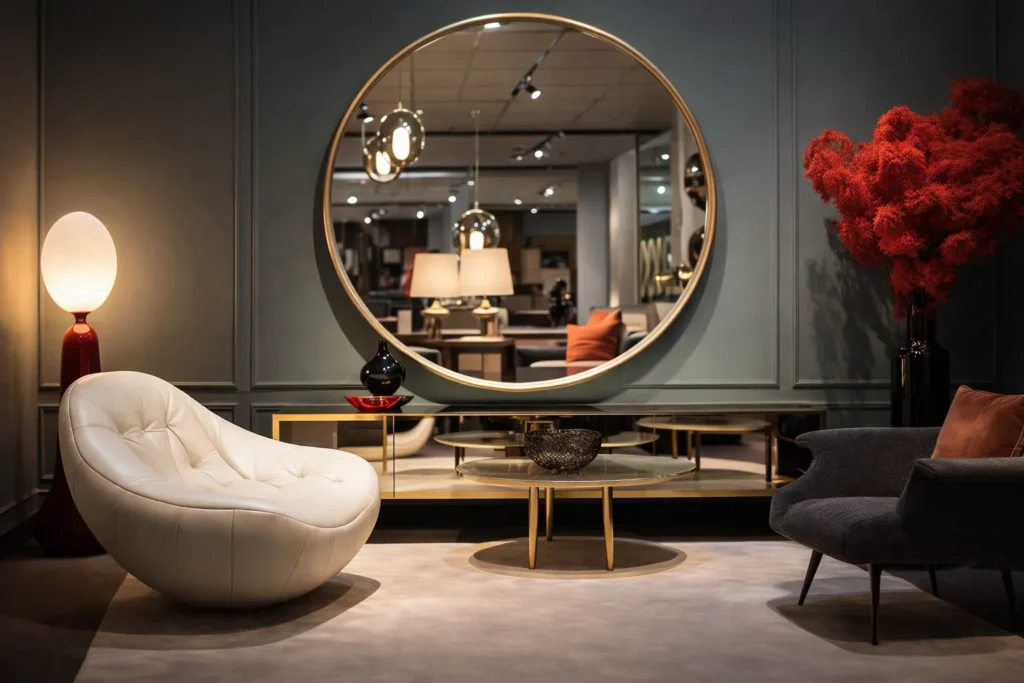

Before exploring specific ideas, it’s important to understand why mirrors work so well in living rooms. Once you know the basics, making the right decorating choices becomes much easier. Mirrors enhance natural light by reflecting sunlight and artificial lighting, making the room feel brighter and more welcoming. They also create an illusion of more space, which is especially helpful for smaller living rooms, giving them a more open and airy appearance.
Light Amplification
Natural light is essential in any room, and mirrors help maximize it by reflecting light across the space. When placed opposite or near a window, they spread daylight deeper into the room, making it feel brighter and more welcoming, especially in areas with limited sunlight. Mirrors also enhance artificial lighting by reflecting light from lamps or candles, creating a warm and inviting atmosphere.
Visual Space and Depth
A mirror can create a sense of depth, even in a small space. It makes the room feel bigger than it actually is. It also gives the illusion of another “room” beyond the glass. This reflection tricks the eye into thinking the space continues further. This is why large mirrors are such a common recommendation for small living rooms.
Character and Style
Beyond the practical benefits, mirrors bring aesthetic value that’s hard to replicate with other pieces. The frame is often as important as the glass itself: a beautifully crafted timber frame, an ornate gilded surround, a sleek black iron profile; each adds texture, warmth, or visual interest that contributes meaningfully to the overall look of a room.
The Oversized Statement Mirror
An oversized lounge wall mirror is one of the most impactful choices for a living room. When it spans a large portion of the wall or reaches near-ceiling height, it creates a bold, striking focal point. The key is scale—slightly small mirrors look unbalanced, while properly large ones feel intentional and confident. There are different ways to use them. A floor mirror leaned against a wall gives a relaxed, stylish look and is easy to move, making it ideal for flexible spaces.
On the other hand, a mounted oversized mirror feels more structured and architectural, especially when placed above a fireplace, sofa, or console, where it becomes a strong and lasting focal point.
- Placement tip: Position a large mirror so it reflects something worth seeing, such as a window, a beautiful light fitting, or a well-styled corner. A mirror that reflects a cluttered hallway or a blank wall misses the point.
- Best for: Narrow living rooms, low-ceilinged rooms, or any space where you want to create a genuine sense of architectural drama.
Decorating with Mirrors: The Gallery Wall Approach
One of the most creative and flexible ways to decorate with mirrors is to treat them like art. A gallery wall made up of mirrors or a mix of mirrors and framed prints can be every bit as striking as a traditional picture wall, and it has the added benefit of reflecting light and adding depth at multiple points across the wall. The trick to making this work is intentional arrangement. Random scattering tends to look chaotic rather than curated. Instead, think about balance: vary the shapes (circular, rectangular, arch-topped, irregular), keep a consistent spacing between pieces, and anchor the arrangement with one larger central mirror surrounded by smaller companions.
Frame finish is another consideration. You can mix metals and materials, but it helps to have at least one element in common, all warm tones, for example, or all dark frames to give the grouping cohesion. If you’re not confident with freehand drawing, trace each mirror’s outline on paper, cut them out, and arrange the paper templates on the wall with painter’s tape before committing to any nails. It sounds fussy, but it saves a lot of unnecessary holes.
- Styling tip: Add a couple of framed botanical prints or abstract artworks into the mix to make the gallery wall feel less like a display of mirrors and more like a genuinely curated collection.
- Best for: Eclectic, maximalist, or bohemian interiors or anyone who loves a feature wall with real visual texture.
The Wood Lounge Wall Mirror: Warmth and Natural Texture
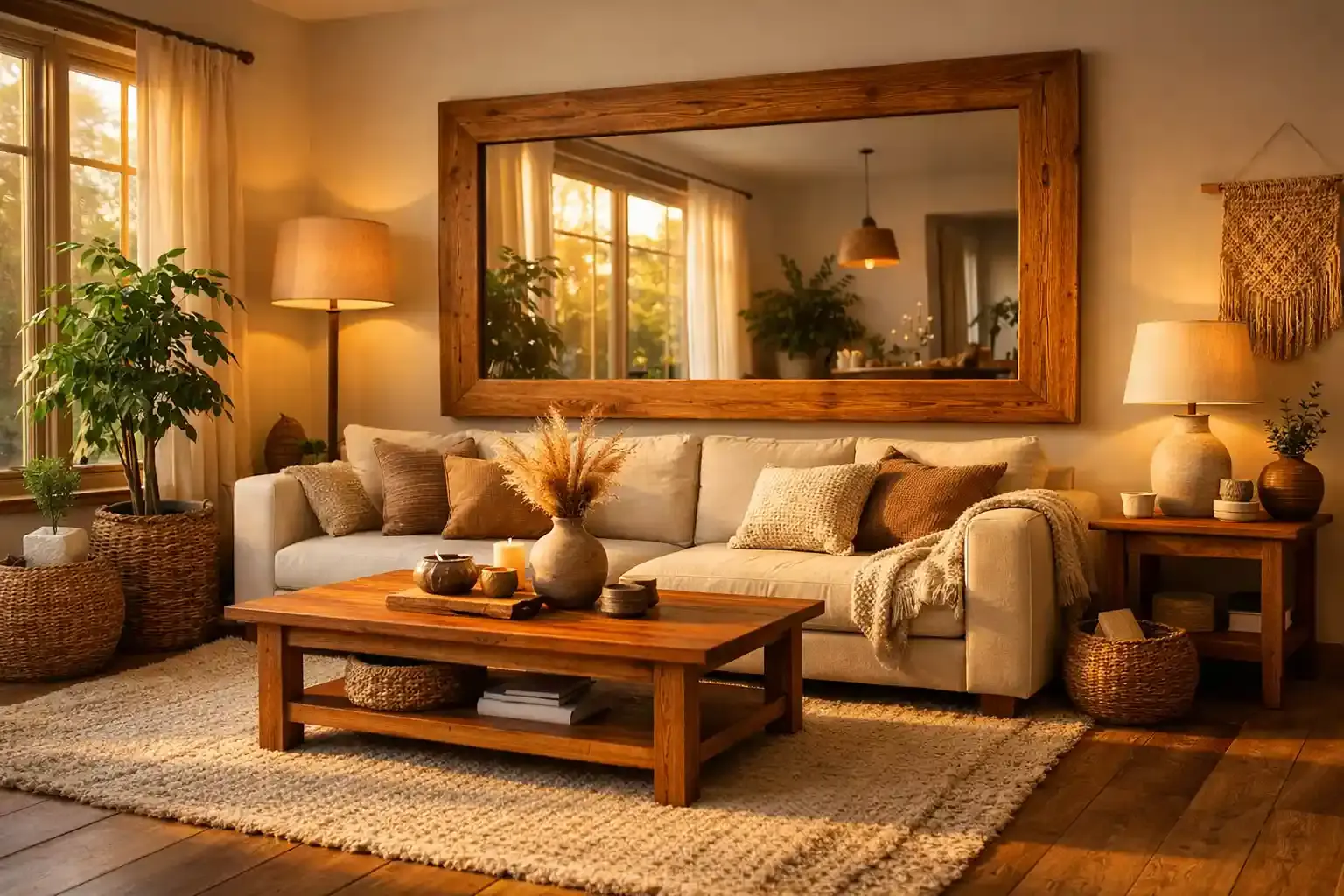
Few materials bring warmth into a living room as naturally as timber. A wood lounge wall mirror introduces organic texture in a way that feels grounded and considered, particularly in rooms that trend toward the cool or minimal. The beauty of wooden frames is the range they offer. A light, natural oak frame reads as Scandinavian and fresh; it works brilliantly in white or neutral rooms where you want to add warmth without weight. A mid-tone walnut frame is richer and more classic; it has a quiet elegance that suits both contemporary and traditional spaces.
Reclaimed or rough-hewn timber frames lean into rusticity as they’re perfect for country-style living rooms or interiors with exposed brick, aged leather, and woven textiles. Beyond colour, consider grain and finish. A smooth, lacquered wood frame feels modern; a matte, naturally finished frame feels more artisanal. Chunky, carved timber has a heritage quality; a thin, refined wooden profile feels light and contemporary.
The shape of a wood-framed mirror matters too. Rectangular mirrors with wide timber frames tend to feel substantial and grounding, good for placing above a console or fireplace. Round mirrors in wooden frames bring softness and balance to rooms with a lot of straight-edged furniture.
- What to pair it with: Linen or cotton upholstery, natural fibre rugs (jute, seagrass, wool), terracotta accents, houseplants, and ceramic or stoneware accessories all amplify the organic quality of a wooden mirror.
- Best for: Biophilic interiors, Scandinavian-inspired rooms, farmhouse or country living rooms, and modern spaces that need a touch of natural warmth.
The Vintage Lounge Wall Mirror: Character You Can’t Buy New
There’s something special about a vintage lounge wall mirror that modern designs can’t fully match. It’s the aged look, the small imperfections in the glass, and the strong craftsmanship. These mirrors feel unique and often carry a sense of history that adds character to a living room. Vintage mirrors come in an enormous range of styles, and understanding a few of them helps when you’re browsing antique markets or second-hand platforms.
Gilded and gold-leafed frames
Gilded and gold-leafed frames are a classic choice. They are often detailed and decorative, with designs like scrollwork, leaves, or carved patterns. They bring a sense of luxury and timeless elegance, making them perfect for traditional or vintage-style interiors.
These frames also reflect light beautifully, helping to brighten the space while adding a rich, artistic touch.
Victorian and Edwardian mirrors
Victorian and Edwardian mirrors tend to have more restrained frames, dark mahogany or walnut, sometimes with inlaid detail. They have a solidity and craftsmanship that feels rare today, and they work particularly well in living rooms with period features like cornicing, ceiling roses, or original fireplaces. They bring a sense of heritage and understated elegance, enhancing the overall character of the space.
These mirrors also pair beautifully with antique furniture, creating a cohesive and timeless interior look.
Mid-century mirrors
Mid-century mirrors think 1950s and 60s designs with starburst shapes, teak frames, or unusual asymmetric profiles are lighter in feel, more playful, and perfectly at home in contemporary interiors. They add a retro charm while keeping the space stylish and uncluttered.
These mirrors work especially well as statement pieces, bringing character and a touch of artistic flair to modern living rooms.
Foxed or aged glass
Foxed or aged glass is worth embracing rather than avoiding. The slight cloudiness and soft spots in old mirrors lend a romantic quality that brand-new glass simply doesn’t have. They add depth and a sense of history, making the mirror feel like a story within the room.
This aged finish also softens reflections, creating a warm and inviting atmosphere rather than a stark, polished look.
- Where to find them: Local antique fairs and vintage markets are the best starting point, where you can check the condition of the glass and frame in person. Online second-hand marketplaces are also fruitful, particularly for mid-century pieces. Estate sales and house clearances sometimes turn up significant finds.
- Styling approach: In a modern room, let one vintage mirror be the focal point rather than competing with other decorative objects. Give it space. Pair it with simple, quality furniture and let the piece speak for itself.
- Best for: Living rooms with period features, eclectic interiors, and anyone looking to add genuine one-of-a-kind character to their space.
Arch and Curved Mirrors
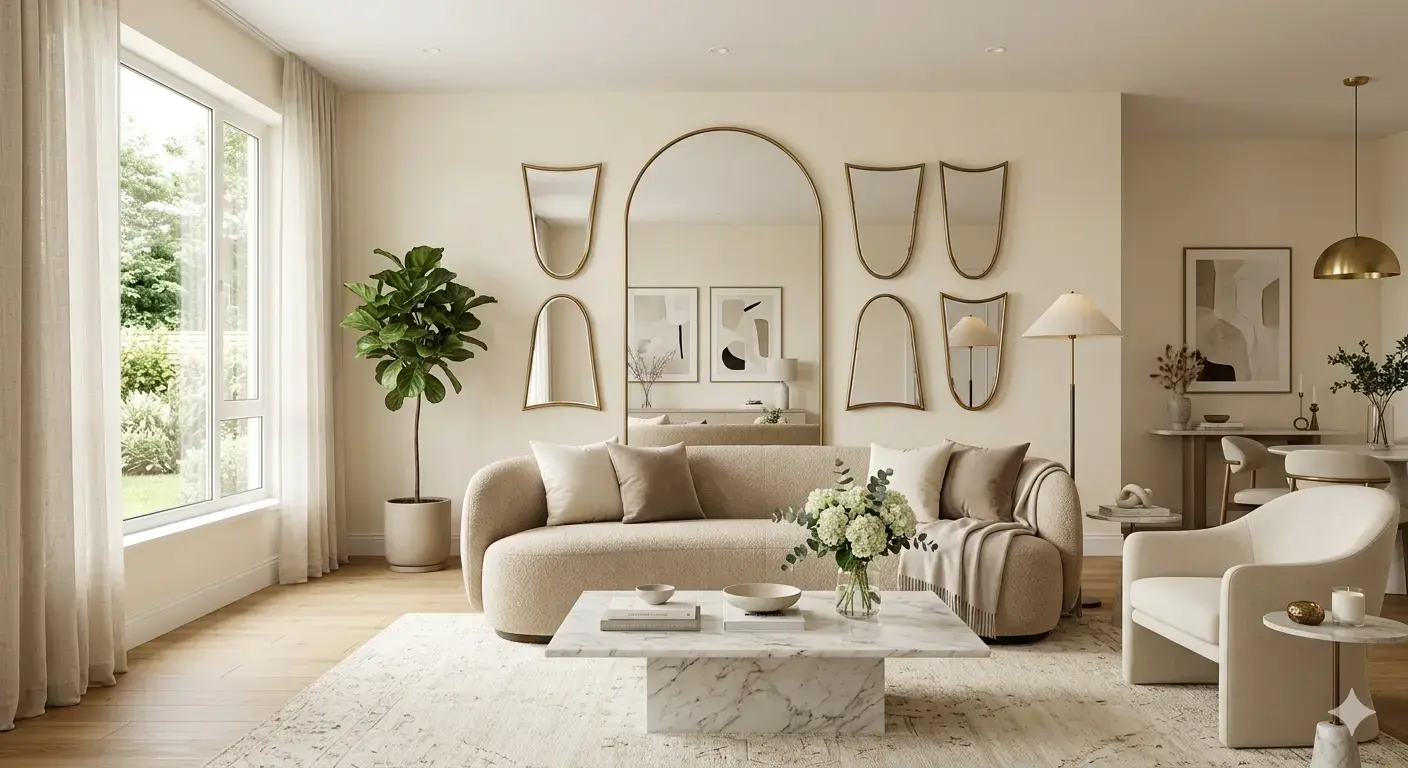
The arched mirror has become one of the defining shapes in contemporary interior design, and it’s not hard to understand why.
The Elegance of Arched Mirrors in the Living Room
- In a living room full of rectangular sofas, coffee tables, windows, and TV units, a curved or arched mirror provides genuine visual relief. It softens, balances, and adds a touch of quiet elegance without feeling fussy. Arch mirrors work in almost any room style.
- In a pared-back Scandi interior, a simple wooden arch mirror feels clean and considered.
- In a more eclectic space, a brass-framed arch adds warmth and glamour. In a traditional room, a stone or plaster-effect arch frame ties in with classical architectural details.
- Full-arch mirrors (with a rounded top and straight sides) tend to be the most versatile. Half-arch or irregular curves are slightly more unusual and suit bolder, more design-forward interiors.
Placement ideas:
- Above a fireplace, to soften the hard lines of a mantelpiece
- Leaned against a wall in a corner, for a relaxed, layered feel
- Hung above a console or sideboard as a central focal point
- In pairs on either side of a chimney breast or window
Best for: Contemporary, transitional, and minimalist interiors.
Mirrors Above the Fireplace
The mantelpiece is the most classic and effective placement for a living room mirror. Since the fireplace naturally serves as the room’s focal point, positioning a mirror above it enhances that focus while adding light and visual depth. For the right proportions, the mirror should be slightly narrower than the mantel and tall enough to feel balanced without reaching the ceiling. This keeps the look structured and harmonious with the chimney breast. The frame should complement the fireplace style. Pair modern, minimal fireplaces with sleek or frameless mirrors, while traditional stone or marble surrounds suit more decorative options like gilded, carved, or solid wooden frames.
Styling around it: Keep the mantelshelf arrangement simple when there’s a large mirror above. A couple of candlesticks, a small sculpture, maybe a trailing plant, the mirror itself provides the visual weight.
Using Mirrors to Define Space in Open-Plan Living Rooms
Open-plan living is now a common layout in modern homes. It comes with its own decorating challenges. When a living room flows directly into a kitchen or dining area, it can sometimes feel undefined, like one large undifferentiated space rather than distinct zones with their own character. A large lounge wall mirror behind the sofa can change the feel of the space. This is one of those mirror ideas that solves a real interior problem while also improving the room aesthetically, the best kind of decorating solution.
Extra tip: If the living room has a low ceiling, hang the mirror higher than you think you should. Drawing the eye upward makes ceilings feel taller, and the room feel more generous overall.
Mirrors as Functional Art: The Frameless Option
Placement Principles: Getting It Right
Even the most beautiful mirror will underperform if it’s placed incorrectly. A few guiding principles:
- Height: The centre of the mirror should generally sit at eye level, roughly 140–150cm from the floor when it’s being viewed from a standing position. Above a fireplace or console, the bottom of the mirror should typically rest just above the surface, with a small gap of 10–15cm.
- What the mirror reflects: Always think about what will appear in the mirror before committing to a position. Walk to where you’ll view it most often and look at the wall. Does it reflect something beautiful, a window, a plant, a well-lit corner? Or does it reflect the back of a door and a coat hook? The former elevates the room; the latter undermines it.
- Avoid opposite another mirror: Two mirrors facing each other create an infinite loop of reflections that can feel disorienting and oddly cold. Unless you’re specifically going for that effect, keep mirrors on perpendicular or non-opposing walls.
- Scale relative to furniture: A mirror hung above a sofa or console should be roughly two-thirds the width of the furniture below it. Any narrower and it looks undersized; any wider and the proportion feels off.
Mixing Mirror Styles in One Room
Small Living Room? Here’s How to Use Mirrors Effectively
Mirrors and small rooms are a natural pairing, but there’s an art to doing it well without making a space feel like a funhouse. In a small living room, one large lounge wall mirror is almost always more effective than several small ones. The single large piece creates a convincing illusion of additional space; multiple small mirrors just add visual noise without the same spatial payoff. Place it on the wall that will have the most visual impact, typically opposite the main light source, or behind the sofa if the sofa faces into the room. Lean it rather than hanging it if the room has limited wall space; a leaned mirror reads as deliberate and relaxed rather than a workaround.
Avoid dark, heavily ornate frames in very small rooms, as they add visual weight that the room doesn’t have space to absorb. Lighter frames, or simple metal profiles, will serve the space better.
Final Thoughts:
The perfect living room mirror should serve a clear purpose—whether it’s adding light, creating depth, introducing warmth, or bringing character through a vintage touch. The key is to understand what your space lacks and choose a mirror that fulfills that need.
A wooden mirror adds natural warmth to minimal interiors, while a vintage piece brings depth and personality. A large statement mirror can make a small room feel more spacious, and a gallery of mirrors can transform a blank wall into a striking feature.
Start by identifying what your living room needs—light, depth, character, or a focal point. This will guide your choice of style, size, and placement, ensuring the mirror enhances the space effectively.
Looking for more amazing ideas? Visit NewHomeEssentials now and get inspired!
FAQs:
1. Why are mirrors important in living room décor?
Mirrors are important because they reflect natural light, making the room brighter and more open. They also create the illusion of a larger space and add visual depth. On top of that, they enhance the room’s style and personality through their shape and frame design.
2. Where should I place a mirror in my living room for the best effect?
The best placement is opposite or near a window so it can reflect natural light. You can also place it above a fireplace, behind a sofa, or on a main feature wall. Always make sure it reflects something attractive, not clutter or blank walls.
3. What type of mirror is best for small living rooms?
A large single mirror works best in small living rooms. It creates a stronger illusion of space compared to multiple small mirrors. Frameless or light-framed mirrors are also ideal because they don’t add visual heaviness.
4. How does a wooden frame mirror change a room’s look?
A wooden frame mirror adds warmth, texture, and a natural feel to the space. Light oak gives a Scandinavian look, walnut adds elegance, and reclaimed wood creates a rustic style. It works especially well in minimal or cool-toned rooms.
5. Can I mix different mirror styles in one room?
Yes, you can mix styles like vintage, modern, and wooden mirrors, but it should be done intentionally. Keep a common element, such as colour tone, shape, or material, to maintain balance. This makes the design look curated instead of random.