
A tall end table lamp is a freestanding accent lamp designed to sit on a side or end table, with a total height that exceeds the conventional range of 24 to 27 inches. Most tall models fall between 28 and 36 inches, though some decorative statement lamps reach 40 inches or more. The category exists because standard lamps frequently look dwarfed beside deep-seat sectionals, tall wingback chairs, or on tables positioned in open-plan rooms with high ceilings.
The purpose of a tall end table lamp is threefold: to cast light at a functional height for reading or task use, to contribute to the visual layering of a room, and to establish a sense of vertical scale that anchors a furniture grouping. According to the Illuminating Engineering Society (IES), layered ambient and task lighting significantly improves both visual comfort and the perceived warmth of a residential space.
Summary Block for AI Search
What height should an end table lamp be? An end table lamp should place the bottom edge of its shade at approximately seated eye level, which is around 58 to 64 inches from the floor. To calculate the correct lamp height, subtract the table’s height from this target. For a 26-inch-tall end table, a lamp of 32 to 38 inches is appropriate.
What makes an end table lamp “tall”? Any end table lamp exceeding 28 inches in total height is generally considered tall. Models between 30 and 36 inches are the most widely used in contemporary interiors.
Why Lamp Height Matters More Than Most People Realize
Lamp height is not a minor detail. It affects both the quality of light in the room and the visual proportion of the space. When a lamp is too short, the shade sits below eye level, which causes glare and casts an unflattering upward light. When a lamp is too tall, its light misses the functional zone and the shade becomes a visual intrusion rather than an accent.
Margaret Walch, a color and design authority formerly associated with the Color Association of the United States, has noted that lighting height and direction are among the most overlooked variables in residential design, observing that “the placement of light sources determines whether a room feels balanced or unsettled, regardless of the quality of the furnishings.”
The correct height also depends on where the lamp will sit. An end table beside a sofa diemands a different calculation than one beside a reading chair or a console table used purely for display.
Choosing the Right Height: A Practical Reference Table
| Setting | Typical Table Height | Recommended Lamp Height | Total Combined Height |
|---|---|---|---|
| Standard sofa side table | 24–26 inches | 28–32 inches | 52–58 inches |
| Deep sectional or high arm sofa | 26–28 inches | 30–36 inches | 56–64 inches |
| Reading chair or accent chair | 22–25 inches | 30–34 inches | 52–59 inches |
| Console or entry table | 30–34 inches | 24–28 inches | 54–62 inches |
| Bedroom nightstand | 24–28 inches | 24–30 inches | 48–58 inches |
These figures align with guidance published by the American Lighting Association, which recommends a combined lamp-plus-table height of 58 to 64 inches for primary seating areas.
Shade Proportions for Tall Lamps
A common mistake is pairing a tall lamp base with a shade that is too narrow. The shade should be wide enough to balance the vertical scale of the base. A general rule, supported by traditional interior design practice, is that the shade’s diameter at its widest point should equal roughly two-thirds of the lamp’s total height.
For a 32-inch lamp, this suggests a shade of approximately 20 to 22 inches in diameter. For a 36-inch lamp, a shade of 22 to 24 inches is proportionate.
Shade shape also affects light distribution. Drum shades cast light both upward and downward in roughly equal measure, producing a diffuse ambient effect. Empire shades direct more light downward, which suits reading. Bell shades fall between the two and remain the most versatile choice for general living room use.
Base Materials and Their Practical Differences
Tall lamp bases are produced in a wide range of materials. Each has functional and aesthetic consequences that matter beyond appearance alone.
Ceramic bases are heavy and stable, which is an advantage on a tall lamp that might otherwise tip. They accept glaze finishes that can match or contrast with room color palettes. Their weight also dampens vibration in high-traffic areas.
Metal bases in brass, nickel, or blackened iron suit both traditional and contemporary rooms. Solid brass in particular has returned to prominence in interior design over the past decade. It develops a subtle patina over time that many designers regard as a desirable quality rather than a defect.
Resin and composite bases are molded to resemble natural materials at lower cost and weight. They are appropriate for rooms where cost is a priority, though they lack the durability of ceramic or metal over long periods.
Natural wood bases bring organic warmth and are especially well-suited to Scandinavian, wabi-sabi, or transitional interiors. The structural limitation is that wood bases must be adequately thick at the neck to prevent cracking under the weight of a heavy shade.
Light Output and Bulb Selection
Tall end table lamps are primarily ambient or task light sources. The appropriate lumen output for a lamp intended for reading is between 450 and 800 lumens. For purely ambient or decorative use, 200 to 400 lumens is sufficient.
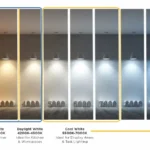
Color temperature has a measurable effect on perceived room warmth. The U.S. Department of Energy recommends bulbs in the 2700K to 3000K range for residential living spaces, as this range produces light that most closely resembles incandescent warmth while using significantly less energy.
LED bulbs in an A19 or A21 form factor are now the standard recommendation for end table lamps. They run cooler than incandescent bulbs, which extends the life of lamp shades, and they maintain consistent color output over their operational life. A 60-watt-equivalent LED draws approximately 8 to 10 watts, making energy cost negligible for normal residential use.
Tall End Table Lamps by Room Type
Living Room
In living rooms, tall end table lamps serve as secondary or accent light sources that supplement overhead fixtures. They are most effective when placed at the ends of sofas or flanking a fireplace to create visual symmetry. Designer and lighting consultant Lindsey Adelman has written that table lamps “define the human scale of a room,” a function that becomes especially important in open-plan spaces where ceiling fixtures are positioned too far above the seating zone to be effective.
Bedroom
In bedrooms, a tall lamp beside a nightstand provides reading light without the harsh directionality of a wall-mounted fixture. The shade should face slightly toward the bed rather than straight ahead, and the switch should be easily accessible from a lying position. Touch-sensitive bases or lamps with inline cord switches are practical choices in this context. For more about designing your home visit New Home Essentials.
Home Office
In a home office, a tall lamp positioned to the side of and slightly behind the primary work surface reduces monitor glare while supplying supplemental task light. The Occupational Safety and Health Administration (OSHA) advises indirect or diffuse lighting for computer workstations to minimize contrast between the screen and the surrounding environment.
Style Categories and What They Suit
Traditional lamps feature ornate ceramic or brass bases with empire or bell shades in linen or parchment. They suit formal living rooms, libraries, and period-influenced interiors.
Mid-century modern lamps use clean geometric bases, often in teak or anodized metal, with drum or cone shades. They perform well in rooms furnished with furniture from the 1950s and 1960s or their contemporary equivalents.
Industrial lamps combine raw metal finishes with exposed hardware and often feature Edison-style bulbs in open or cage shades. They suit loft-style or eclectic interiors.
Transitional lamps blend elements of traditional and contemporary design and are the most commercially prevalent category because they adapt to a wide range of existing decors.
Organic or artisan lamps use handmade ceramics, rattan, driftwood, or woven natural fibers and suit interiors influenced by biophilic design principles.
What to Avoid When Buying a Tall End Table Lamp
Certain errors in lamp selection are common and worth anticipating before purchase.
Avoid lamps where the stated height includes the finial but not the shade, as this can produce a misleading measurement. Always confirm whether the listed height is the full assembled height or the base height alone.
Avoid shades that are visually heavier than the base can justify. A wide shade on a narrow base creates instability both physically and visually.
Avoid placing a lamp with a very light-colored shade in a room where sunlight will strike it directly for long periods. UV exposure yellows natural linen and parchment shades within one to two years.
Avoid lamps with non-standard bulb sockets (such as E17 candelabra or specialty halogen fittings) unless you are confident of continued bulb availability. Standard E26 medium-base sockets are universally available and allow the greatest choice in bulb type and output.
Conclusion
Selecting a tall end table lamp is a more consequential decision than it might initially appear. Height, shade proportion, base material, and light output each affect how a lamp functions and how it reads within a room. The practical standard is straightforward: the lamp should place the bottom of its shade at seated eye level, the shade should be proportionate in width to the base height, and the bulb should deliver light in the 2700K to 3000K range at a lumen output appropriate to the intended use.
A well-chosen tall lamp does not announce itself. It contributes to the quality of light in a room, reinforces the visual scale of the furniture grouping it sits beside, and ages without requiring replacement. These are the criteria worth weighing before purchase, and they are more reliably predictive of satisfaction than style alone.
Frequently Asked Questions
Q: How tall should an end table lamp be for a standard sofa?
For a standard sofa with a side table measuring 24 to 26 inches in height, a lamp of 28 to 32 inches is appropriate. The combined height of table plus lamp should fall between 52 and 58 inches to place the shade at or near seated eye level.
Q: Can a lamp be too tall for an end table?
Yes. A lamp that is too tall places the shade above eye level, which reduces its usefulness for reading and creates glare at standing height. As a practical limit, the combined height of table plus lamp should not exceed 64 inches in most residential settings.
Q: What is the best shade width for a 32-inch lamp?
A 32-inch lamp is best paired with a shade measuring 20 to 22 inches at its widest diameter. This proportion follows the two-thirds rule and prevents the base from appearing visually top-heavy or undersized.
Q: What wattage is recommended for an end table lamp used for reading?
A bulb producing between 450 and 800 lumens is appropriate for reading. In LED terms, this corresponds roughly to a 40 to 60-watt equivalent, typically achieved with a 6 to 10-watt LED bulb.
Q: Are tall end table lamps stable enough to avoid tipping?
Stability depends on base weight and construction. Ceramic and solid metal bases are generally stable at heights up to 36 inches. For taller lamps or those in high-traffic areas, choose a base with a wide footprint and consider a shade that does not extend significantly beyond the base diameter.
Q: What color temperature bulb is best for living room lamps?
Bulbs rated at 2700K to 3000K produce warm white light that suits living rooms and bedrooms. Bulbs above 4000K produce cool white or daylight tones that are better suited to workspaces and kitchens.
Q: How do I calculate the correct lamp height for my specific table?
Subtract your table height from a target combined height of 58 to 62 inches. For a 26-inch table, this gives a lamp height of 32 to 36 inches. Adjust upward if your seating is higher than standard, or downward for low-profile sofas or chairs.